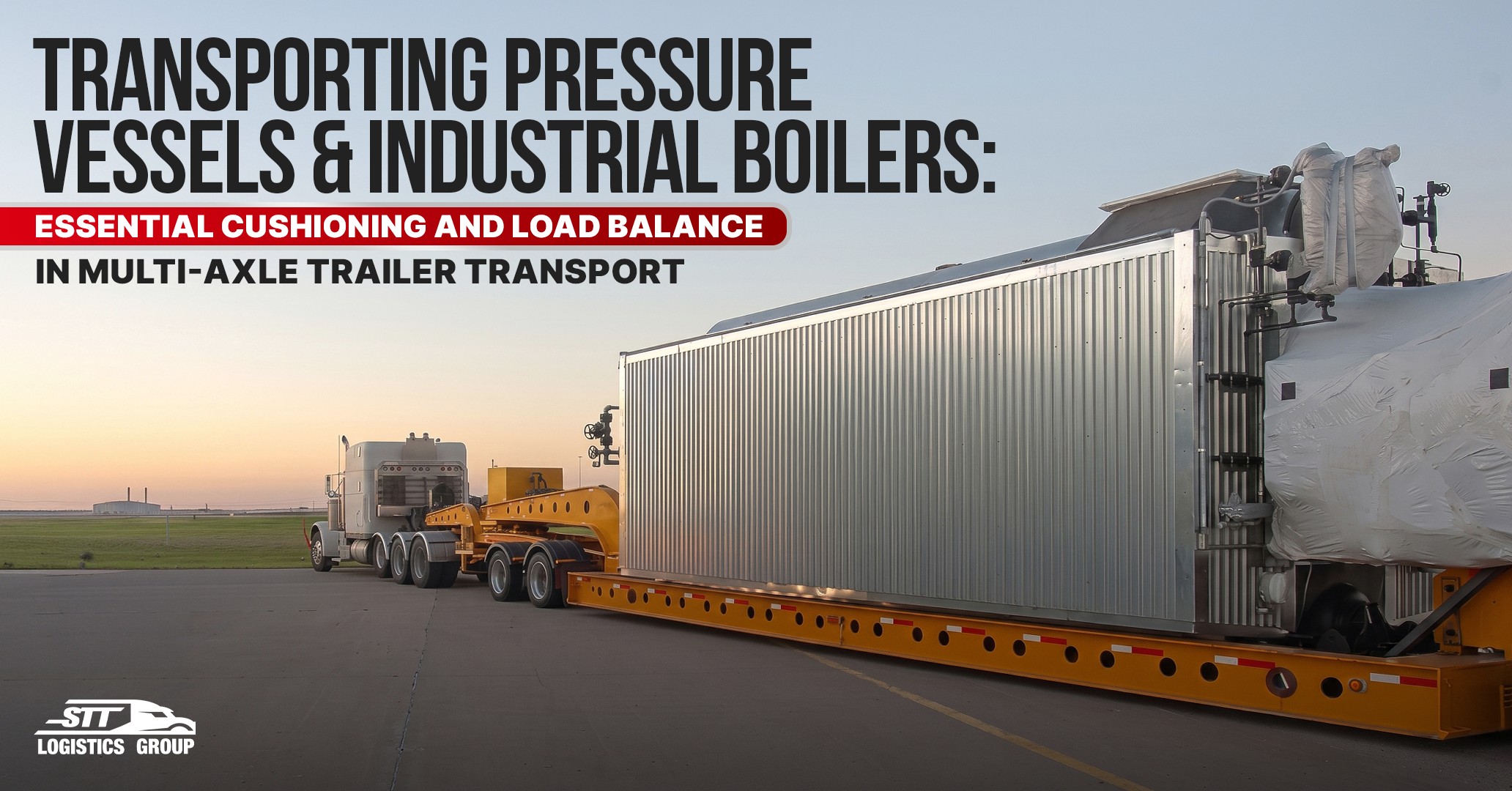

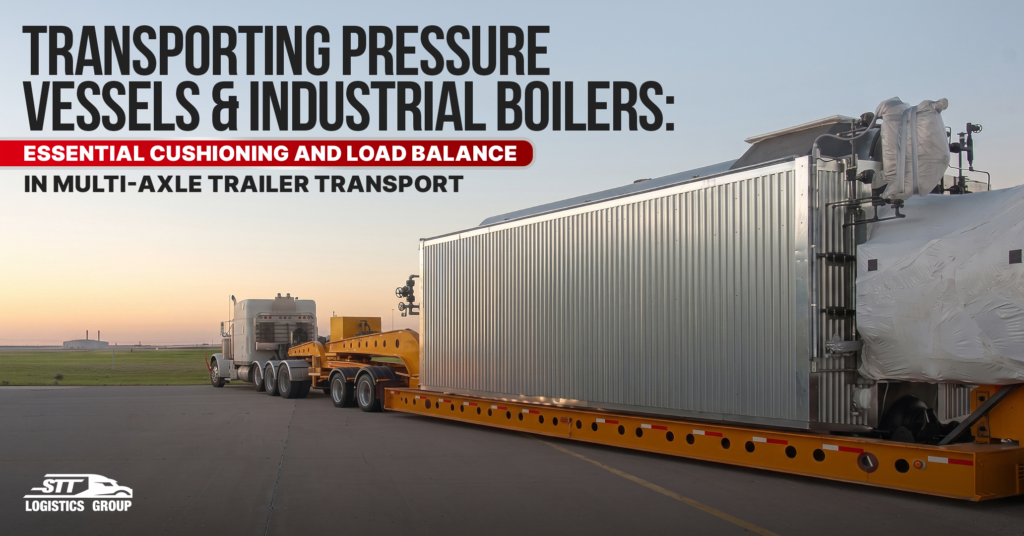
Moving heavy industrial equipment—such as pressure vessels, autoclaves, and industrial boilers—presents unique logistical challenges. Because these units are dense, extremely heavy, and frequently top-heavy, standard flatbeds cannot safely handle them. Instead, specialized multi-axle trailer transport is required to distribute thousands of pounds evenly across road surfaces while protecting delicate internal mechanics from road shock.
Here is a look at why proper load balancing and shock absorption (cushioning) are critical for successful heavy-haul operations.
1. Mastering Load Balance Across Hydraulic Multi-Axle Trailers
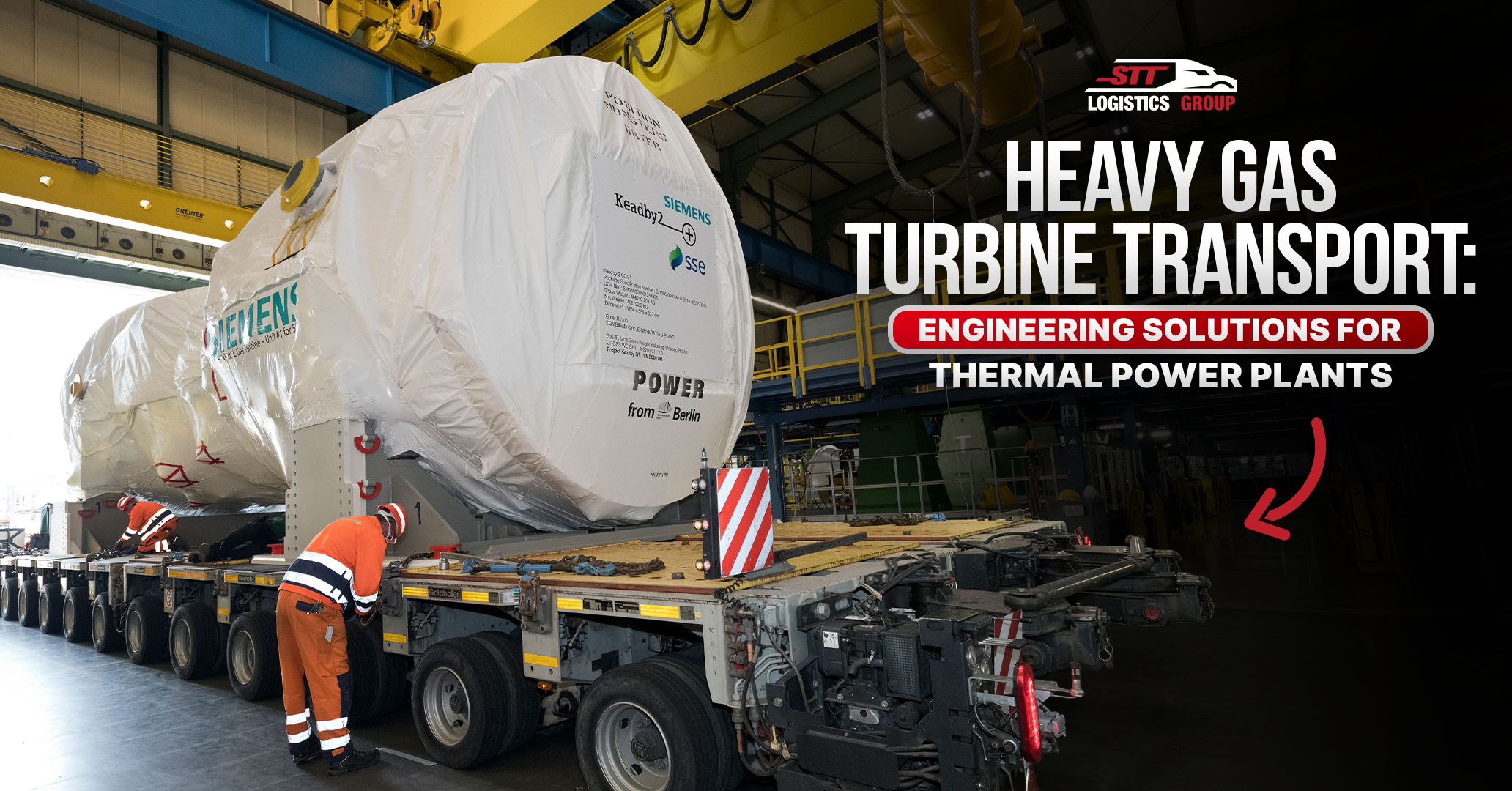
When transporting massive cylindrical vessels, precise weight distribution prevents structural stress on both the trailer and the cargo. Consequently, hydraulic multi-axle trailers (such as SPMTs or multi-axle heavy haulers) are deployed to spread the payload weight evenly across multiple suspension points.
- Axle Weight Limits: State and federal DOT regulations strictly regulate axle weight limits to protect bridge infrastructure and highway pavement. According to statistics compiled by the U.S. Department of Transportation (USDOT) Freight Management and Operations, state permitting agencies issue over 3.5 million oversize/overweight (OS/OW) permits annually, with weight distribution being the most scrutinized factor during route clearance.
- Center of Gravity (CoG): Industrial boilers often feature irregular internal weight centers due to internal piping, firetubes, or asymmetric nozzles. Therefore, heavy haul engineers calculate the exact center of gravity before loading to ensure the trailer frame remains perfectly level throughout transit.
2. Advanced Cushioning: Protecting Fragile Structural Integrity
Although pressure vessels are built out of thick steel to withstand intense internal pressure, they remain surprisingly vulnerable to external dynamic loads, road vibrations, and sudden impacts during transit.
To mitigate these risks, several advanced cushioning techniques are implemented:
- Custom Wooden & Composite Saddles: Tailored saddles made from high-density timber or engineered polymers are molded directly to the curvature of the vessel shell. As a result, point-loading is minimized, and shock forces are cushioned effectively.
- Air-Ride & Hydraulic Suspension Systems: Modern multi-axle trailer transport utilizes active hydraulic suspensions. These systems dynamically absorb highway bumps, preventing micro-fractures in welded seams or refractory linings inside boilers.
- Damping Ties and Polyester Webbing: High-tensile tie-downs combined with specialized rubber damping pads are applied to secure the vessel. Consequently, metal-to-metal chafing is eliminated while thermal expansion or slight flex is safely accommodated.
3. Why Professional Engineering Matters
Transporting high-value industrial equipment is never a matter of simple loading and driving. On the contrary, comprehensive route surveys, bridge formulas, turn-radius simulations, and specialized tie-down engineering must be prepared beforehand. When balance or cushioning is neglected, catastrophic frame sagging or load shifts can occur.
By relying on specialized equipment and experienced heavy-haul specialists, your critical assets are protected from factory floor to job site installation.
Ready to Move Your Heavy Equipment?
At STT Logistics Group, we specialize in complex heavy haul solutions, permitting, and specialized multi-axle trailer transport for industrial boilers, pressure vessels, and oversized machinery across North America.
🛠️ Get Your Free Quote Today!
Don’t leave your oversized cargo to chance. Contact our heavy-haul engineering team today to get your free quote and custom transport plan.
📲 Follow us on our new official page: @sttlogisticsgroup to stay updated on our latest heavy-haul projects and industry insights!