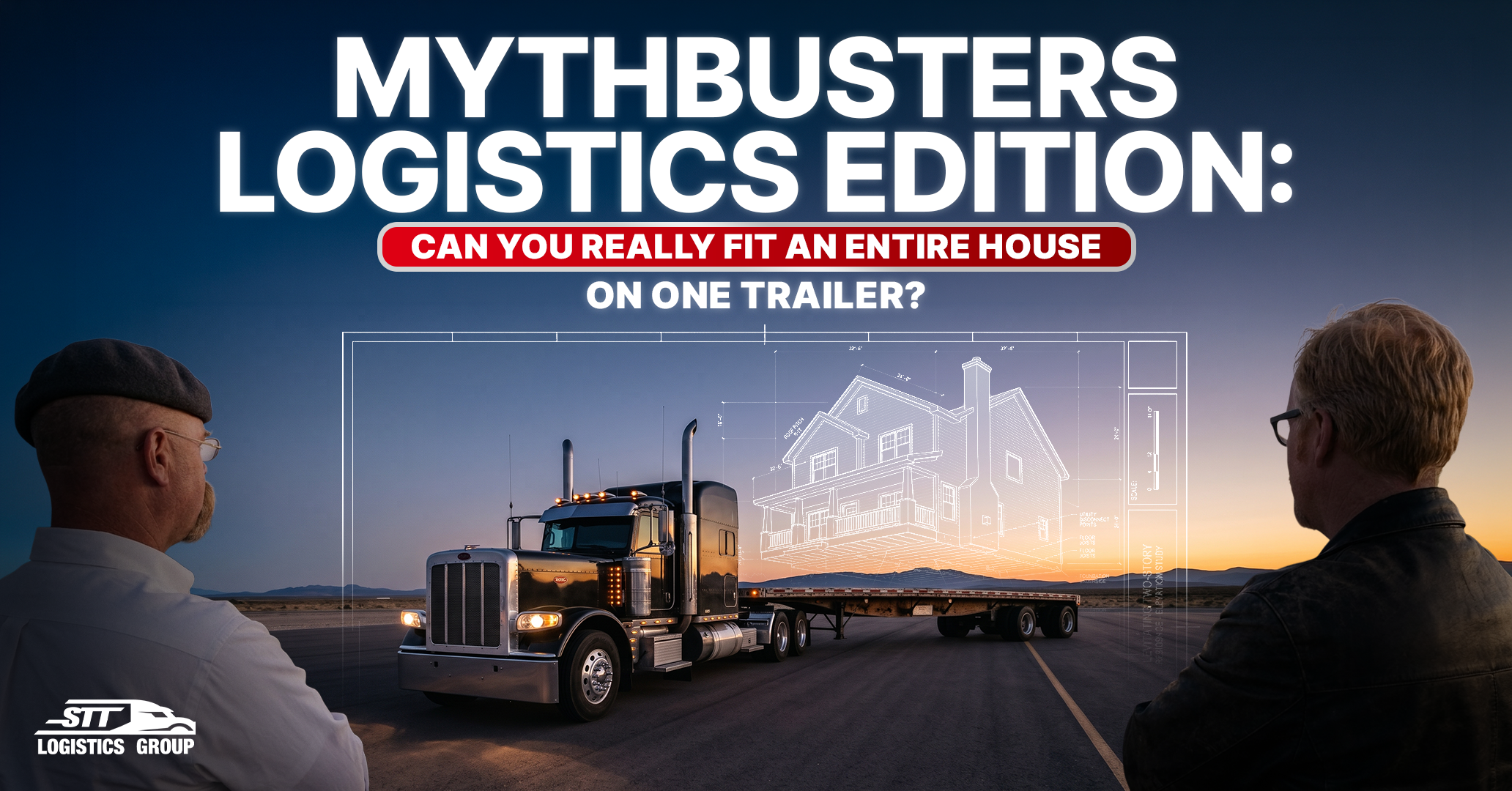

Look at a typical single-family home from the street, and the idea of lifting it onto eighteen wheels sounds absurd. Yet on highways across North America, drivers regularly spot massive structures cruising along the right lane behind pilot cars. This sight fuels a persistent question in freight and construction: can you actually fit an entire house on a single trailer?
The short answer is both yes and no. While traditional site-built homes are never moved in a single haul, modern oversized modular transport has made shifting large residential structures routine. To understand what is fact and what is fiction, we must unpack the engineering, equipment, and regulations behind hauling a home.
The Myth: Any House Can Be Hauled in One Piece
The popular misconception stems from viral videos showing massive colonial homes rolling slowly down closed suburban streets. In reality, moving an existing, traditionally built home involves hydraulic jacking, temporary steel frame insertion, and specialized multi-axle dollies—not a single standard commercial trailer.
Furthermore, weight and structural rigidity impose hard limits. According to data from the National Association of Home Builders (NAHB), a typical single-family home weighs around 80,000 to 160,000 pounds or more depending on materials, framing, and foundation style. Transporting a structure of that mass on a single standard freight bed without catastrophic cracking or road failure is physically impossible.
Consequently, homes are either built specifically for transport—such as manufactured and modular structures—or sliced into precise components prior to transit.
The Reality: How Modular and Manufactured Homes Actually Move
Modern off-site construction relies on precise modular engineering. Rather than building a house as an inseparable box, manufacturers fabricate houses in standardized volumetric sections called modules.
Each module is engineered to withstand wind sheer, highway vibration, and lifting stresses. Once fabrication finishes at the plant:
- Manufactured (HUD-Code) Homes: These structures are built directly onto a permanent steel chassis equipped with integrated axles and hitch points. As a result, they do not sit on a flatbed; instead, they roll directly on their own running gear behind heavy-duty transport tractors.
- Modular Homes: Modules are constructed off-site to local building codes, then loaded onto specialized trailers. Once delivered, each section is hoisted off the transport deck by crane and secured to a permanent foundation, where utility lines and structural seams are joined.
Matching the Load: Double-Drop vs. Multi-Axle Trailers
When standard dry vans or flatbeds fall short, specialized heavy-haul equipment takes over. Successful oversized modular transport depends heavily on choosing the exact deck profile:
| Trailer Type | Best Application | Key Structural Advantage |
| Double-Drop (Lowboy / RGN) | Tall volumetric units and prefab cabins | The deck sits merely 18 to 24 inches above the asphalt, allowing tall modules to clear interstate bridge heights without route detours. |
| Modular Multi-Axle Transporters | Ultra-heavy commercial sections and concrete panels | Axle lines can be coupled in sequence, distributing immense ground pressure across dozens of independent tires to satisfy bridge formulas. |
| Extendable (Stretch) Flats | Extended structural pods and roof trusses | Telescopic center beams allow trailers to extend beyond 60 feet, preventing unsafe overhangs for elongated segments. |
Navigating Permits, Bridges, and Route Logistics
Even when a structure fits onto a heavy-haul deck, moving it through public infrastructure demands rigorous planning. A route is never chosen at random; rather, it is surveyed mile by mile.
Before a load departs, state DOT permits are secured for height, width, length, and gross vehicle weight. If a modular section exceeds 12 to 14 feet in width, escort vehicles equipped with height poles and amber beacons are deployed to lead the convoy. Bridges must be vetted against national gross-weight distribution standards, and utility companies are often coordinated with in advance to lift low-hanging power lines along secondary roads.
Thanks to meticulous engineering and route logistics, entire multi-story residences are regularly assembled on-site within days—transported safely, one high-spec section at a time.
Plan Your Next Heavy Haul with STT Logistics Group
Moving oversized freight requires zero guesswork and reliable execution. At STT Logistics Group, your specialized cargo is managed from initial route surveys to final delivery by our experienced heavy-haul specialists.
Ready to get your next project on the road? Contact STT Logistics Group today for your free quote and experience seamless freight solutions built around your timeline. Don’t forget to follow our new official page @sttlogisticsgroup for industry updates, route insights, and heavy-haul field breakdowns.