
Transporting super-heavy or over-dimensional freight requires careful planning and specialized equipment. Project managers often face a critical decision: should they select conventional heavy-haul trailers or advanced modular solutions? Modern transport challenges demand equipment that handles extreme weight while navigating tight spaces safely. Hydraulic suspension multi-axle trucks—such as those engineered by Goldhofer and Scheuerle—have transformed the heavy transport industry by introducing unprecedented stability, maneuverability, and load distribution capabilities.
Understanding the key differences between Self-Propelled Modular Transporters (SPMTs) and conventional trailers ensures your high-value cargo arrives safely, on time, and within budget.
What Are Hydraulic Suspension Multi-Axle Trucks?
Unlike standard flatbed or lowboy trailers that rely on mechanical leaf springs or air suspension systems, hydraulic suspension multi-axle trucks feature independent hydraulic cylinders on each axle line. These advanced systems distribute enormous weights evenly across all wheels, protecting both the trailer structure and the road infrastructure.
According to research published by the Federal Highway Administration (FHWA), overweight loads exceeding standard permit limits require precise axle load distribution to prevent pavement damage and structural bridge stress. Hydraulic suspension systems adjust dynamically to uneven terrain, keeping the cargo perfectly level even when navigating steep gradients or rough ground.
SPMTs vs. Conventional Heavy-Haul Trailers: A Technical Comparison
Choosing between SPMTs and conventional heavy-haul trailers depends directly on cargo weight, route geometry, and site constraints.
| Feature | Conventional Trailers | Modular Trailers & SPMTs (Goldhofer / Scheuerle) |
| Maneuverability | Fixed or mechanical steering (wider turning radius) | 360-degree electronic multi-way steering |
| Propulsion | Requires external heavy-duty tractor unit | Self-propelled via integrated Power Pack Units (PPUs) |
| Payload Capacity per Axle Line | Typically 10 to 12 tons per axle line | 30 to 60+ tons per axle line |
| Operation Mode | Driver inside the cab | Precision wireless remote control |
| Best Used For | Long-distance highway transport | On-site positioning & confined space moves |
1. Maneuverability in Confined Spaces
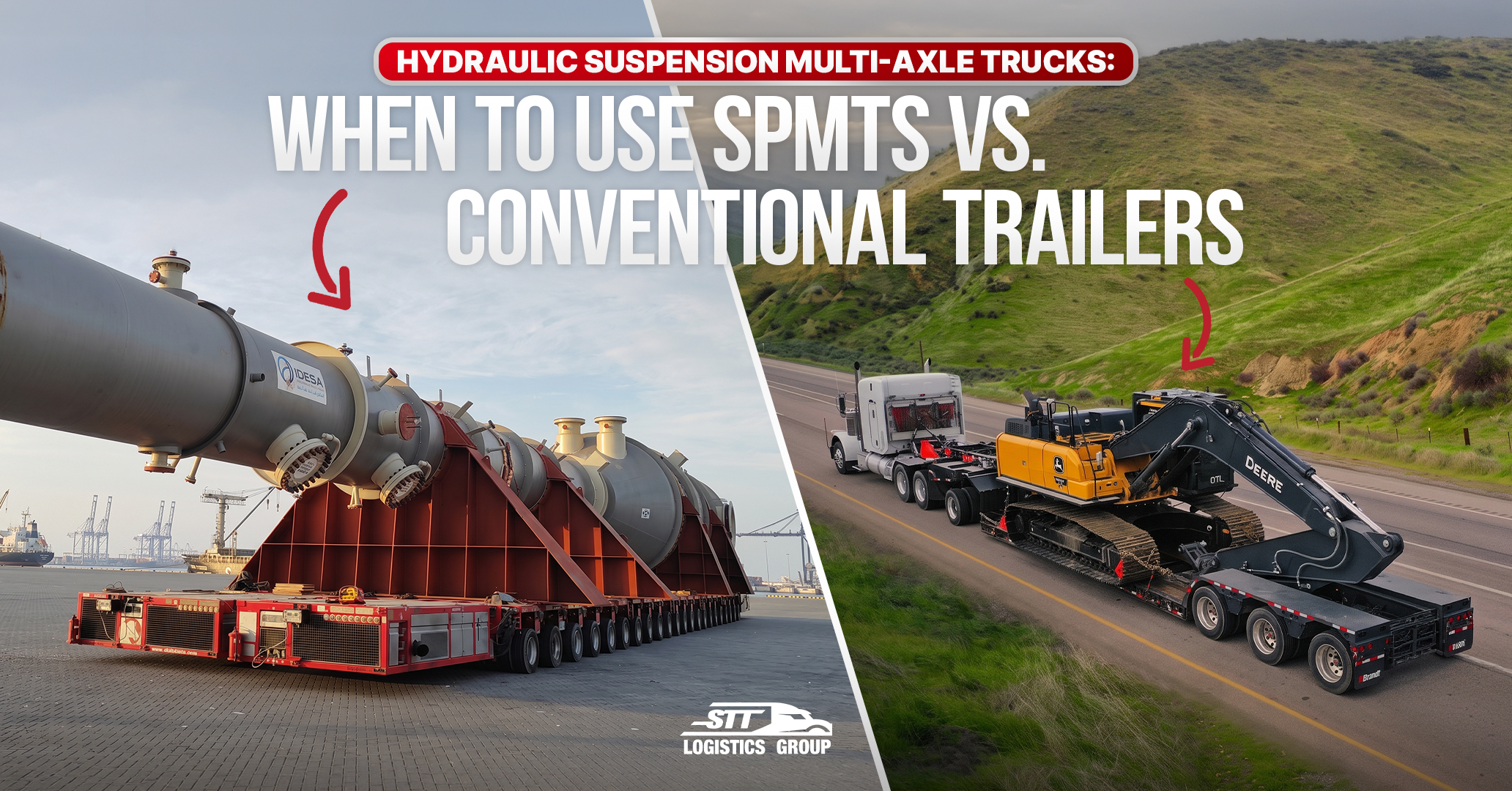
Conventional trailers work exceptionally well for highway transit; however, they require wide turning radii and clear, unobstructed roads. Conversely, SPMTs equipped with Goldhofer or Scheuerle technology feature 360-degree electronic multi-mode steering. Operations teams can steer axles independently, enabling crab steering, carousel turning (turning on the spot), and diagonal movements.
Consequently, when maneuvering massive industrial components within tight refinery boundaries or urban jobsites, SPMTs operate with millimeter precision where tractor-pulled trailers simply cannot fit.
2. Axle Line Capacity and Load Distribution
Standard trailers distribute weight across a limited number of fixed axles. In contrast, modular hydraulic suspension multi-axle trucks allow operators to combine axle lines laterally and longitudinally.
By utilizing hydraulic pendular axles, SPMTs offer up to 45–60 tons of capacity per line. As a result, massive payloads—such as offshore wind turbine components, transformers, or industrial reactors—are supported evenly. The hydraulic compensation system continuously balances fluid pressure across axles, ensuring stability even on uneven ground.
3. Remote Control and Operational Precision
While conventional transport relies on driver coordination from a tractor cab, SPMTs are operated via ergonomic wireless remote control units. Operators walk alongside the equipment, maintaining a clear, direct line-of-sight to the cargo and potential obstacles at all times.
Therefore, remote-controlled hydraulic suspension multi-axle trucks significantly improve safety standards during delicate positioning tasks, such as placing a bridge girder onto its piers or loading a vessel via Roll-on/Roll-off (RoRo) ramps.
When Should You Choose SPMTs Over Conventional Trailers?
- Use Conventional Heavy-Haul Trailers when moving moderate heavy-haul equipment over long distances on open highways where turning radius is not severely restricted.
- Use SPMTs / Hydraulic Modular Trailers when moving extreme loads (hundreds or thousands of tons) in confined industrial sites, ports, or congested construction zones where precision maneuvering and maximum axle capacity are mandatory.
Partner with STT Logistics Group for Your Heavy-Haul Projects
Navigating complex heavy-haul logistics requires the right equipment, technical expertise, and detailed route engineering. At STT Logistics Group, we deliver custom transport solutions using state-of-the-art hydraulic suspension multi-axle trucks tailored to your project’s exact requirements.
Are you planning an upcoming heavy-haul project? Contact STT Logistics Group today to claim your FREE QUOTE! Our heavy transport specialists are ready to optimize your logistics strategy.
Don’t forget to follow us on our new official page @sttlogisticsgroup for industry insights, project updates, and expert heavy transport solutions!