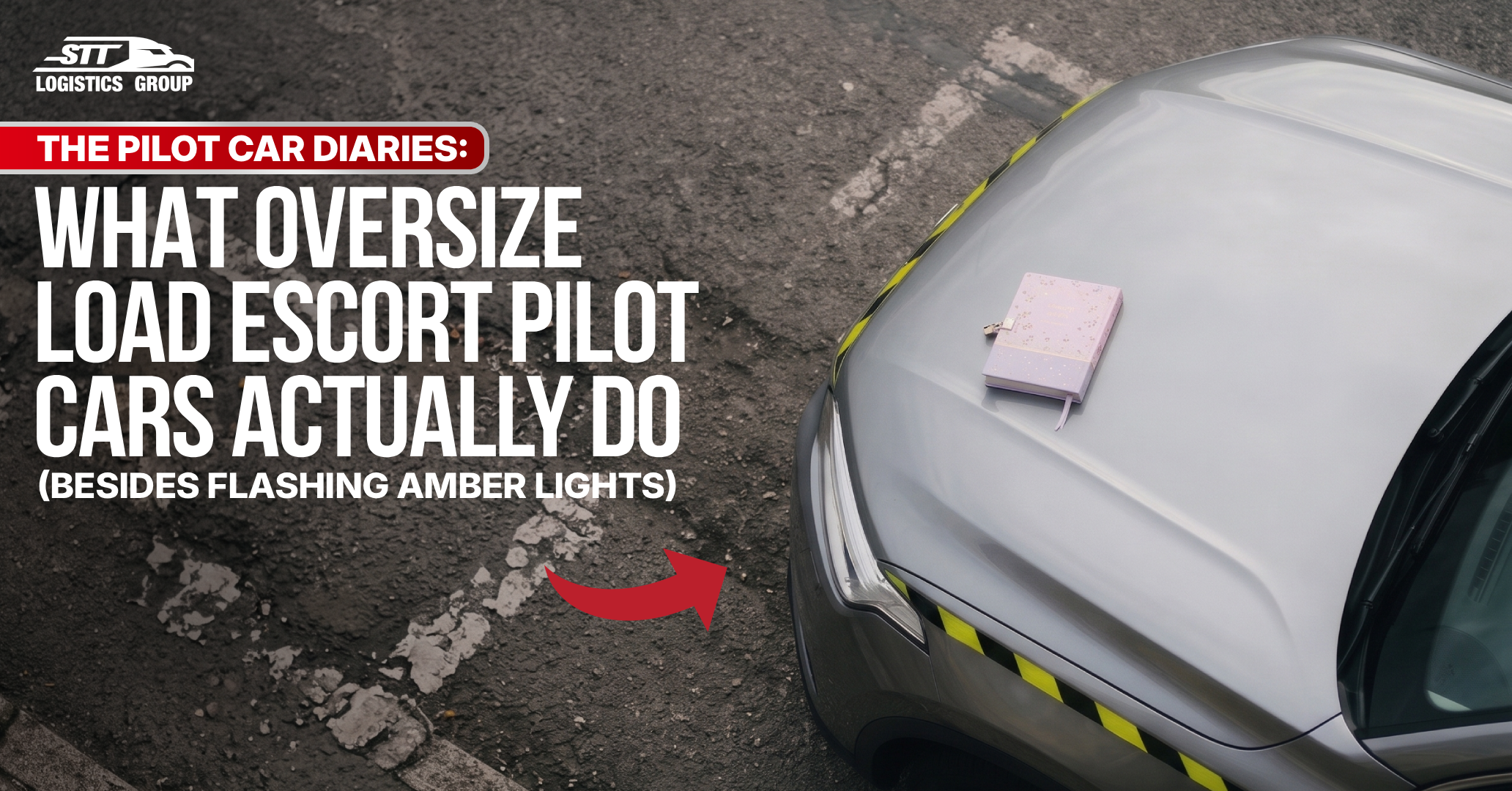
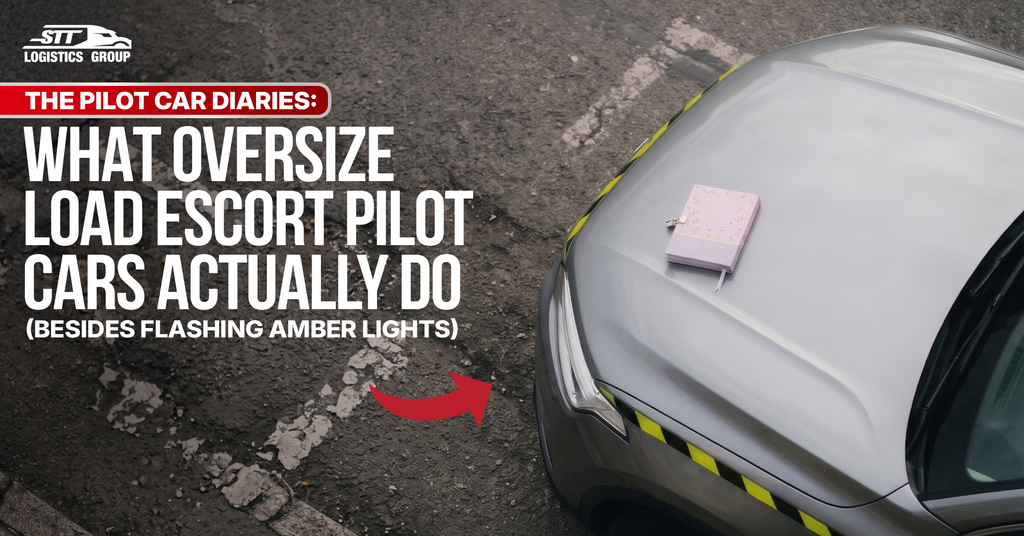
From the outside, it looks like the easiest gig on the interstate: drive ahead in a pickup truck, flick on a set of amber strobe lights, and cruise down the highway.
In reality, oversize load escort pilot cars serve as the frontline defense between an 80-ton industrial turbine and a low-hanging fiber-optic line that could shut down power for an entire county. When massive freight hits public roads, these drivers act as navigators, bridge scouts, traffic coordinators, and emergency spotters—all while rolling at 60 mph.
A Day in the Life: Height Poles, Narrow Passes, and Radio Static
The shift begins well before dawn at a roadside staging area. While the heavy-haul driver checks chains and securement points, the lead pilot car operator calibrates the height pole. This flexible fiberglass wand mounted to the front bumper is set precisely a few inches higher than the highest point of the load.
As the convoy rolls out, the lead driver maintains a steady distance ahead. When an overpass looms, the lead vehicle clears it first. If the pole strikes a cable or concrete girder, the warning is immediately radioed back: “Stop load, overhead hazard ahead.”
Split-second decisions are constantly required. Consider what happens when approaching a two-lane rural truss bridge:
- Lane Control: The pilot car positions itself to temporarily block oncoming traffic, allowing the wide-load hauler enough clearance to take the center of the span.
- Blind-Spot Clearing: On sharp mountain switchbacks, escort vehicles verify that the trailer swing will not clip guardrails or oncoming passenger cars.
- Utility Awareness: Low-hanging power cables are identified in real time, preventing catastrophic line strikes.
While the heavy-haul trucker maneuvers the tractor-trailer, situational awareness is maintained by the escort team. Without that constant stream of communication, multi-million-dollar cargo would simply not make it to its destination in one piece.
When Does a Commercial Load Require Escort Pilot Cars?
Regulations vary significantly across state and provincial lines, but escort requirements are generally triggered when cargo exceeds standard legal dimensions:
- Width: Loads wider than 10 to 12 feet typically require at least one chase vehicle; loads exceeding 12 to 14 feet often mandate both front (lead) and rear (chase) escorts.
- Height: Cargo standing taller than 14 feet 6 inches frequently mandates a certified lead car equipped with an active height pole.
- Length & Overhang: Overall vehicle combinations exceeding 90 to 100 feet—or carrying rear overhang past state thresholds—require rear escorts to guard turning radiuses and rear-end collisions.
- Route Specifics: Heavy hauls through congested metropolitan areas or designated mountainous corridors are often subject to mandatory police escorts alongside civilian pilot vehicles.
The risks of moving oversize freight without proper route survey and escort planning are substantial. According to safety analysis published by the Federal Highway Administration (FHWA), non-divisible commercial loads moving under state-issued oversize/overweight (OS/OW) permits require strict compliance with routing restrictions, travel-time curfews, and certified pilot escort vehicle (P/EV) guidelines specifically to prevent catastrophic infrastructure strikes and bridge damage.
Consequently, safe delivery is achieved only through disciplined logistics planning. Proper route surveys identify low clearances, construction zones, and tight intersections days before rubber ever touches the road.
Move Your Heavy Haul Safely with STT Logistics Group
Hauling oversized machinery, transformers, or structural steel requires precision from departure to delivery. At STT Logistics Group, our logistics coordinators manage route surveys, state permitting, and certified oversize load escort pilot cars to keep your freight compliant and secure across North America.
Ready to schedule your next major haul? Contact us today to claim your free quote!
Don’t forget to follow our journey on our brand-new page: @sttlogisticsgroup.