Dating in the modern world is complicated, but finding the right trailer for an oversized machine might be even harder. If job-site titans traded dirt trenches for swipe apps, what would their bios look like? Beyond the horsepower and charming yellow paint, every machine has specific logistical requirements that dictate how it must be transported.
Before diving into their bios, consider the scale of this industry. According to market research from Grand View Research, the global heavy construction equipment market was valued at over $204 billion and continues to expand steadily toward nearly $290 billion. Consequently, thousands of oversized machines are hauled across national highways every single week.
Here is what happens when you evaluate these mechanical giants through their hypothetical dating profiles—and the exact heavy construction equipment transport setups they demand.
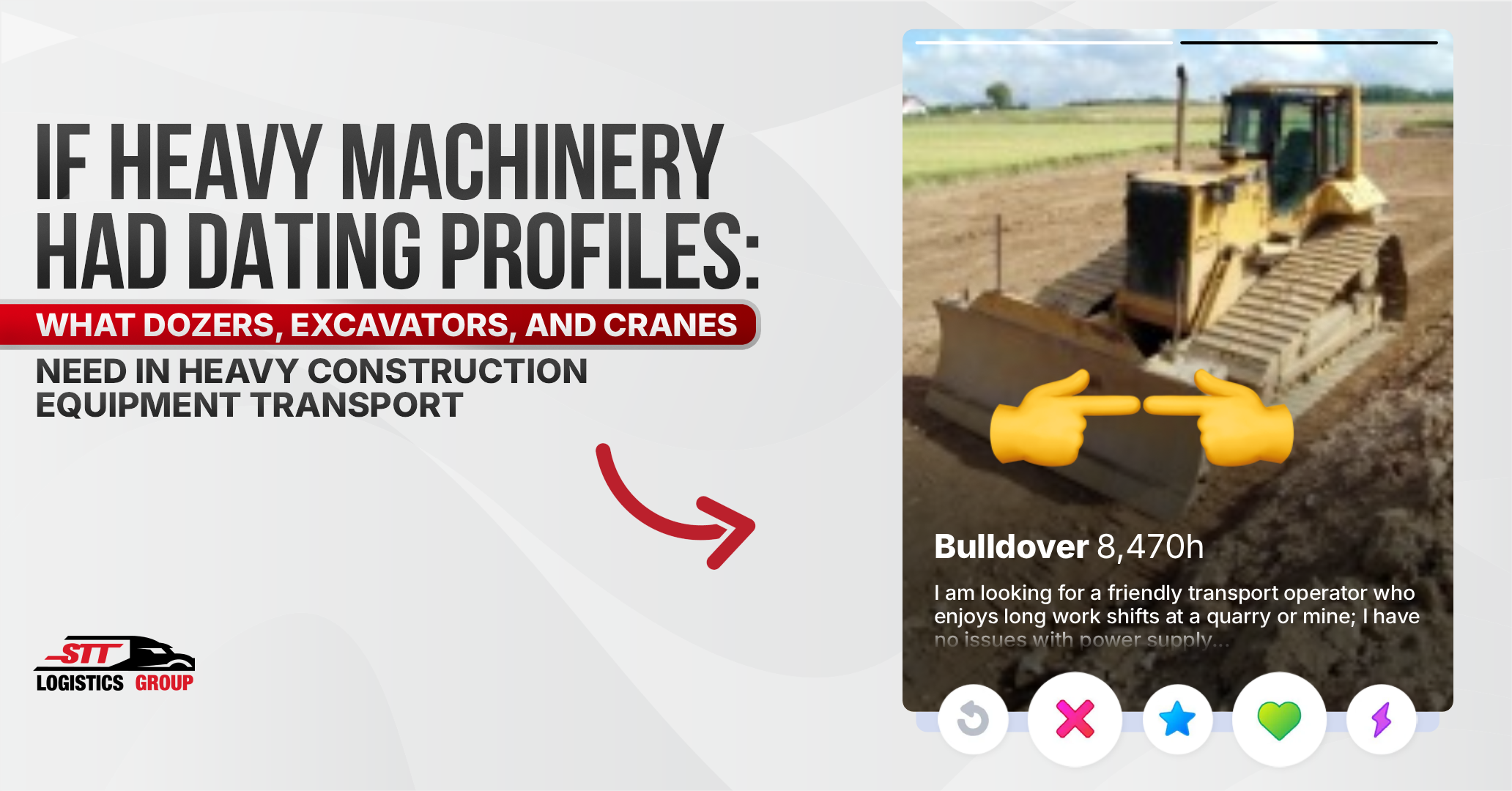
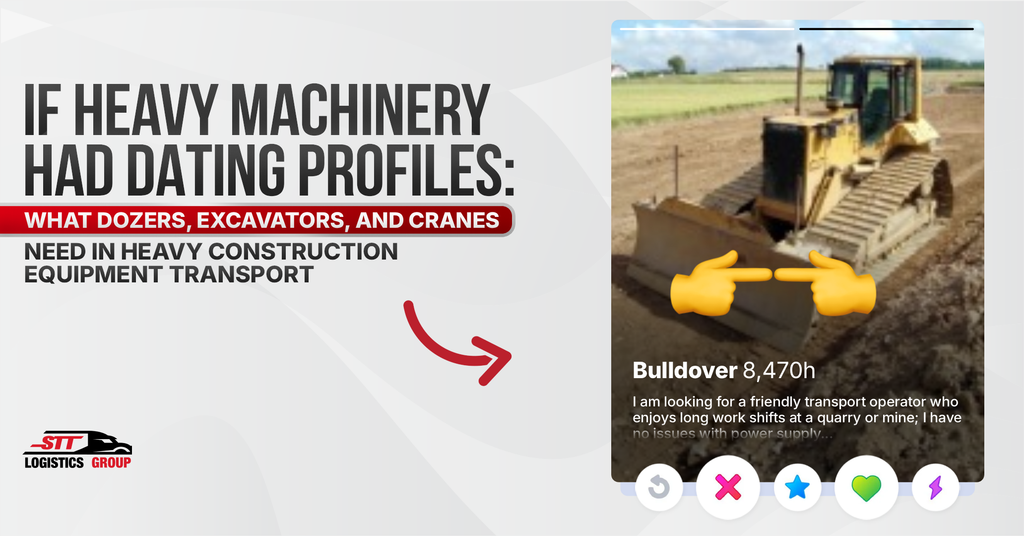
1. The CAT Bulldozer: “The Unstoppable Powerlifter”
- Bio: “Loves pushing boundaries, leveling obstacles, and long walks across raw earth. Not big on delicate conversations. If you can’t handle me at my earth-shattering worst, you don’t deserve me at my grade-perfect best. Swipe right if you like stability.”
- Primary Uses: Earthmoving, site clearance, land grading, and demolition push-work.
- Weight Class: A standard CAT D6 weighs around 40,000 to 50,000 lbs, whereas massive models like the CAT D8 or D9 easily exceed 85,000 to 110,000 lbs.
- Trailer Requirements: Because tracked dozers cannot drive long distances without chewing up asphalt, a specialized flat-deck solution is needed. Smaller models can travel on standard step-decks, but heavyweight dozers require a Removable Gooseneck (RGN) / Lowboy trailer. Furthermore, wide straight blades must frequently be detached or angled, and state oversize permits are arranged by logistics specialists to comply with legal lane widths.
2. The Hydraulic Excavator: “The Deep Thinker”
- Bio: “360-degree vision, great reach, and always digging into the deeper things in life. I bring a lot of baggage (buckets, thumbs, hydraulic breakers), but I know how to handle high pressure. Looking for someone grounded.”
- Primary Uses: Trenching, foundation digging, material handling, pipe laying, and demolition.
- Weight Class: Standard crawler excavators (such as a 20-ton CAT 320) sit between 45,000 and 55,000 lbs, while large production excavators push past 90,000 lbs.
- Trailer Requirements: Height is the true dealbreaker here. When an excavator boom rests on a trailer deck, bridge clearances are quickly challenged. Therefore, low-profile RGNs or well-deck trailers are utilized to keep total transit height under the legal 13’6″ threshold. In addition, boom articulation must be chained securely with rated tie-downs to ensure zero movement during transport.
3. The All-Terrain Crane: “The High-Maintenance Overachiever”
- Bio: “Always reaching for the stars. I have high standards, a towering presence, and I rarely travel alone—my counterweights need their own ride. Let’s see if our chemistry can handle the tension.”
- Primary Uses: Structural steel erection, industrial rigging, bridge construction, and high-altitude lifting.
- Weight Class: Varies drastically from 60,000 lbs for compact rough-terrain units to well over 150,000+ lbs for multi-axle all-terrain and crawler cranes.
- Trailer Requirements: Cranes are often too heavy and complex for ordinary haulers. Consequently, multi-axle perimeter trailers, drop-decks, and custom jeep/stinger combinations are dispatched to distribute axle weight across highway bridges. Furthermore, dedicated support trailers are assigned to haul the counterweights, boom inserts, and outrigger pads separately.
Finding the Perfect Match for Your Fleet
Just like modern romance, successful heavy haul shipping requires clear communication, the right dimensions, and zero surprises on the road. Without proper planning, costly fines and transit delays are quickly accumulated.
When your machinery is ready to move, let STT Logistics Group handle the matchmaking. Our team manages permits, pilot escorts, and specialized trailer dispatch so your equipment arrives safely and on schedule.
Ready to get moving? [Contact STT Logistics Group today for your FREE quote!]
Don’t forget to connect with us—follow our brand-new page on Instagram and Facebook at @sttlogisticsgroup for behind-the-scenes hauls, heavy machinery tips, and industry updates!